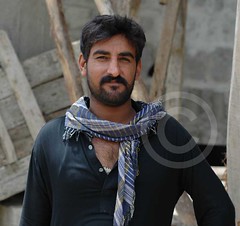
This is Arshad Khan, my waterproofing labour and Afridi pathan. Afridi pathans are numerous in Pakistan and are considered most handsome among all Pashtuns. They are proud and strong and hard working. I suspect that many of them now living in Karachi have become quite lazy - but not Arshad.
For Roof, Basement and Bathroom waterproofing in Pakistan please contact Ameer Hamza at 0301-2228210 or email at ameer.great@gmail.com. You may also find details and prestigious projects completed in Pakistan here.
Showing posts with label pakistan. Show all posts
Showing posts with label pakistan. Show all posts
Tuesday, August 7, 2012


Tuesday, May 22, 2012
Time for prayers, Karachi
Via Flickr:
Muslims pray for their Asar namaz (known as Sala'h in Arabic). Asar is the 3rd namaz among 5 daily obligatory prayers in Islam.
Paradise point beach is one of the most famous soft sand beaches of Pakistan.
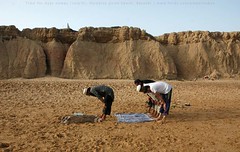
Muslims pray for their Asar namaz (known as Sala'h in Arabic). Asar is the 3rd namaz among 5 daily obligatory prayers in Islam.
Paradise point beach is one of the most famous soft sand beaches of Pakistan.
Sunday, February 5, 2012
Breakfast: French toast with cream, honey and chai, Karachi
Via Flickr:
French toast cooked by my wife.
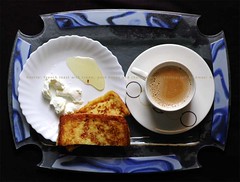
French toast cooked by my wife.
Thursday, February 2, 2012
Dinner: Safed Paplet (White Pomfret), Karachi
Via Flickr:
Fried with green masala, a local recipe of my mother in a pan with oil. Eaten raw or with roti and piyaz (onions).
Pomfret is known as paplet is perhaps the most popular fish eaten among the Gujrati familes of Pakistan and India, perhaps due the fact that Gujratis have been eating this fish since last few centuries. Best season for fishing pomfret in Arabian Sea is between Sep-Jan, December being the best month. We got this fish for Rs.900/ Kg, which makes it one of the most expensive eatable fish in Pakistan. And this was rather small. Large size was Rs.1,200 / Kg. We call it 'Paplet', a lovely name.

Fried with green masala, a local recipe of my mother in a pan with oil. Eaten raw or with roti and piyaz (onions).
Pomfret is known as paplet is perhaps the most popular fish eaten among the Gujrati familes of Pakistan and India, perhaps due the fact that Gujratis have been eating this fish since last few centuries. Best season for fishing pomfret in Arabian Sea is between Sep-Jan, December being the best month. We got this fish for Rs.900/ Kg, which makes it one of the most expensive eatable fish in Pakistan. And this was rather small. Large size was Rs.1,200 / Kg. We call it 'Paplet', a lovely name.
Tuesday, January 31, 2012
Madani mirch or talhi hui mirch, Karachi
Via Flickr:
Green chillies are slit open and then zeera and salt are placed inside each of them. Cooked in oil until fried. But never deep fried and never use red chillies. These are Pakistani chillies.
Cooked by my wife.

Green chillies are slit open and then zeera and salt are placed inside each of them. Cooked in oil until fried. But never deep fried and never use red chillies. These are Pakistani chillies.
Cooked by my wife.
Sunday, January 15, 2012
Dinner: Home made pizza with russian salad
Via Flickr:
Pakistanis have so much altered this Italian dish that Italian national would find it hard to recognize the ingredients except for the erstwhile cheese. Like all great cooks of the world we tend to improvise according to the tastes and sensibilities of our nation. Therefore, unknown to Italians, Pakistani pizzas have such ingredients as chicken tikka or massala tikka - loads of it - daubed with chadder and mozrilla cheese, shimla mirch (green chilli), a wonderful pizza paste and a very thick bread. Cut tomatoes and onions are the staples. My sister also added russian salad for the added taste. No Pepsi, though!

Pakistanis have so much altered this Italian dish that Italian national would find it hard to recognize the ingredients except for the erstwhile cheese. Like all great cooks of the world we tend to improvise according to the tastes and sensibilities of our nation. Therefore, unknown to Italians, Pakistani pizzas have such ingredients as chicken tikka or massala tikka - loads of it - daubed with chadder and mozrilla cheese, shimla mirch (green chilli), a wonderful pizza paste and a very thick bread. Cut tomatoes and onions are the staples. My sister also added russian salad for the added taste. No Pepsi, though!
Wednesday, January 11, 2012

Sunday, December 4, 2011
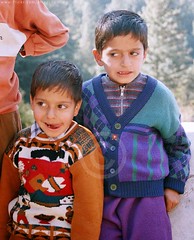
Portraits from Kashmir : Chikar village
November, 2005 | After Earthquake
Via Flickr:
I very clearly remember this cold morning of November, 2005. Waqar, a friend of mine from Muhammad Ali Jinnah University (MAJU), had accompanied me to this village alongwith members of Dawat-e-Islami to distribute aid among the quake survivors. These two children had also arrived alongwith their father or grandfather. And the younger one just looked too mischievous - and tempting - for a frame.
Via Flickr:
I very clearly remember this cold morning of November, 2005. Waqar, a friend of mine from Muhammad Ali Jinnah University (MAJU), had accompanied me to this village alongwith members of Dawat-e-Islami to distribute aid among the quake survivors. These two children had also arrived alongwith their father or grandfather. And the younger one just looked too mischievous - and tempting - for a frame.
Sunday, November 27, 2011
Published: Express Tribune Mag Nov 27- Dec 3, 2011
Article by Adil Mulki
Photographs by Ameer Hamza
As so happens with so many Pakistan-based publications, the editors really don't consider publishing the name of the photographer(s). And that is a sad reality and reflects the general thinking among the editors here: Photographs are not as important as a write-up. They are wrong. And everyone else is wrong who considers photographs as secondary. You just need to pick any issue of National Geographic.
You may read the wonderfully penned article here:
'Outside, the desert sun beats down on the baked and barren dunes, but inside the customised SUV, it’s another world. The AC is on full blast and the tinted windows filter the unforgiving rays of the sun into diffused light. Plush seats provide a level of comfort one would find impossible to imagine in such a harsh environment. Beep…beep…beep. The silence is broken by the sound of the scanner; the vehicle comes to a sudden halt, sending the soft desert sands cascading down the dune that it is now precariously perched atop.'
More...http://tribune.com.pk/story/296325/inglourious-bustards/#comment-437326
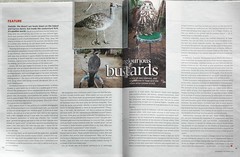
Photographs by Ameer Hamza
As so happens with so many Pakistan-based publications, the editors really don't consider publishing the name of the photographer(s). And that is a sad reality and reflects the general thinking among the editors here: Photographs are not as important as a write-up. They are wrong. And everyone else is wrong who considers photographs as secondary. You just need to pick any issue of National Geographic.
You may read the wonderfully penned article here:
'Outside, the desert sun beats down on the baked and barren dunes, but inside the customised SUV, it’s another world. The AC is on full blast and the tinted windows filter the unforgiving rays of the sun into diffused light. Plush seats provide a level of comfort one would find impossible to imagine in such a harsh environment. Beep…beep…beep. The silence is broken by the sound of the scanner; the vehicle comes to a sudden halt, sending the soft desert sands cascading down the dune that it is now precariously perched atop.'
More...http://tribune.com.pk/story/296325/inglourious-bustards/#comment-437326
Wednesday, November 23, 2011
Feeding marsh crocodiles at Sufi Shrine, Karachi
Date: 3rd June, 2007.
This is Sheedi, or black man, standing among the most dangerous crocodiles on Earth: Marsh crocodiles from River Nile. No one knows how they ended up here, thousands of miles from their original place, in the barren of Karachi at a Sufi Shrine near Karachi (now Manghopir, as this place is called, is part of Karachi due to horizontal expansion of the city).
The legend is that these crocodiles are actually lice of the Saint, who threw them into this spring. And they became crocodiles!
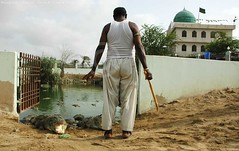
This is Sheedi, or black man, standing among the most dangerous crocodiles on Earth: Marsh crocodiles from River Nile. No one knows how they ended up here, thousands of miles from their original place, in the barren of Karachi at a Sufi Shrine near Karachi (now Manghopir, as this place is called, is part of Karachi due to horizontal expansion of the city).
The legend is that these crocodiles are actually lice of the Saint, who threw them into this spring. And they became crocodiles!
Tuesday, November 22, 2011
Making ablutions at Shrine of Hazrat Mian Sher, Sharakpur Sharif
Date: 8th June, 2011.
This is my friend and travel partner, Adeel, making Wuzu (Islamic ablutions) at the Mazar / Shrine of Hazrat Mian Sher Muhammad. About him, one website has this to say, 'Hazrat Mian Sher Muhammad was one of the famous Saints of Punjab who got a reputation in Naqshbandiyyah Series (Silsala). He was born as a saint.' ..... And, 'With his blessings many dead hearts were lightened with divine light. Even still now his name is called with respect and devotion.
The Naqshbandy forefathers of Hazrat Mian Sher Muhammad migrated from Kabul to Punjab and lived in Qasoor. Then migrated from Qasoor to Hujra Shah Makeem and then Sharaqpur. The father’s name of Hazrat Mian Sher Muhammad was Mian Aziz Aladdin. His ethnicity was Arian. His family’s professional business was cultivation. Hazrat Mian Sher Muhammad was born in Sharaqpur in 1865 CE (1282 H). After his birth from his body and shining face, the symptoms of as a saint were clear.'
You may read full details about this and other Saints of Sharaqpur Sharif (Lonely Planet Guide to Pakistan pronounces it as 'Sharakpur' Sharif).
http://www.sharaqpur.com/Hazrat_Mian_Sher_Muhammad.aspx
It is essential part of Sunni Barelvi belief system that before entering graveyard (qabar'istan) and therefore, any Tomb / Shrine, one must be ritually pure. Therefore, we Sunni Barelvis make wuzu before making our hazri (appearance) in front of Sufi Saint.
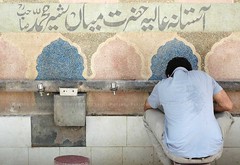
This is my friend and travel partner, Adeel, making Wuzu (Islamic ablutions) at the Mazar / Shrine of Hazrat Mian Sher Muhammad. About him, one website has this to say, 'Hazrat Mian Sher Muhammad was one of the famous Saints of Punjab who got a reputation in Naqshbandiyyah Series (Silsala). He was born as a saint.' ..... And, 'With his blessings many dead hearts were lightened with divine light. Even still now his name is called with respect and devotion.
The Naqshbandy forefathers of Hazrat Mian Sher Muhammad migrated from Kabul to Punjab and lived in Qasoor. Then migrated from Qasoor to Hujra Shah Makeem and then Sharaqpur. The father’s name of Hazrat Mian Sher Muhammad was Mian Aziz Aladdin. His ethnicity was Arian. His family’s professional business was cultivation. Hazrat Mian Sher Muhammad was born in Sharaqpur in 1865 CE (1282 H). After his birth from his body and shining face, the symptoms of as a saint were clear.'
You may read full details about this and other Saints of Sharaqpur Sharif (Lonely Planet Guide to Pakistan pronounces it as 'Sharakpur' Sharif).
http://www.sharaqpur.com/Hazrat_Mian_Sher_Muhammad.aspx
It is essential part of Sunni Barelvi belief system that before entering graveyard (qabar'istan) and therefore, any Tomb / Shrine, one must be ritually pure. Therefore, we Sunni Barelvis make wuzu before making our hazri (appearance) in front of Sufi Saint.
Monday, November 21, 2011
Pakistani truck, Indus Highway, Sindh
We were going to Sehwan Sharif. I think we were four then: Me, Suffian Adhia, Raja Islam and Uzair Tahir. Or, maybe, one of the last two were missing. I cannot now recall because I don't have a group photograph. But I can very clearly recall the heat outside the car. The heat of Sindh is remarkable: It can kill you instantly.
This decorated truck was moving slowly in front of our speeding car. Being a double track (2-way traffic) the incoming cars were not allowing any space to move ahead of this truck. I took advantage of this situation and took the shot using, perhaps, Raja's Canon. I am happy with the results. And I am always happy when I see well maintained, decorated Pakistani trucks on the road. They are a moving form of cultural / folk art.

This decorated truck was moving slowly in front of our speeding car. Being a double track (2-way traffic) the incoming cars were not allowing any space to move ahead of this truck. I took advantage of this situation and took the shot using, perhaps, Raja's Canon. I am happy with the results. And I am always happy when I see well maintained, decorated Pakistani trucks on the road. They are a moving form of cultural / folk art.
Sunday, November 20, 2011
Chestnut tree leaves, Chitral
In my diary style reporting on the latest trip (9th September, 2011 - 25th September, 2011) I did not mention this photograph of chestnut tree leaves lying on the garden just outside the Chitral Fort.
I like this photograph very much. Firstly, because a traveller to Chitral MUST never miss them. This tree epitomizes the stature of the man in Chitrali society. I was informed by a local Chitrali that every self-respecting must have this tree in his home garden. By that definition, the most powerful and rich man in Chitral, the Mehtar of Chitral (former rulers) should have lots of good chestnut trees. And sure enough there are those large, over 100-years old, grand chestnut trees all over the place. Their size must be understood via this frame of giant leaves on the floor.
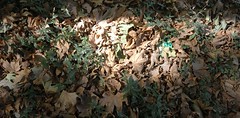
I like this photograph very much. Firstly, because a traveller to Chitral MUST never miss them. This tree epitomizes the stature of the man in Chitrali society. I was informed by a local Chitrali that every self-respecting must have this tree in his home garden. By that definition, the most powerful and rich man in Chitral, the Mehtar of Chitral (former rulers) should have lots of good chestnut trees. And sure enough there are those large, over 100-years old, grand chestnut trees all over the place. Their size must be understood via this frame of giant leaves on the floor.
Tuesday, November 15, 2011
Places in Pakistan: Ayun valley, Chitral dist.
Via Flickr:
September 23, 2011 at 12.42pm PKT
We were already late because I and Adeel had been roaming around the fort and then talking with the manager of the lodge. All that time, three others had been waiting impatiently near our hired car. According to them, when finally we reached them, we had wasted a lot of time and that we must be responsible, if we cannot make across the curfew. The curfew, as I was to know later, is in place every evening at Lowari tunnel due to Taliban. And I knew that we would be racing against time and military wallahs. I also knew that there would be no photography at or around Lowari tunnel, a project imitated by General Musharraf to ease the traffic flow in that strategically important area. Hence, we moved away and reached this beautiful place. Everyone, including Zahid bhai, who'd be dripping with anger, jumped out of the station wagon to shoot this stunning landscape.
One of the most beautiful valleys of Pakistan, Ayun valley is the gateway to the famous Kalash Kafir villages. I was lucky to have shaded clouds, which provided me with a classic landscape shot.
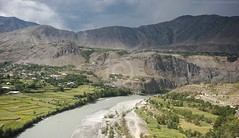
September 23, 2011 at 12.42pm PKT
We were already late because I and Adeel had been roaming around the fort and then talking with the manager of the lodge. All that time, three others had been waiting impatiently near our hired car. According to them, when finally we reached them, we had wasted a lot of time and that we must be responsible, if we cannot make across the curfew. The curfew, as I was to know later, is in place every evening at Lowari tunnel due to Taliban. And I knew that we would be racing against time and military wallahs. I also knew that there would be no photography at or around Lowari tunnel, a project imitated by General Musharraf to ease the traffic flow in that strategically important area. Hence, we moved away and reached this beautiful place. Everyone, including Zahid bhai, who'd be dripping with anger, jumped out of the station wagon to shoot this stunning landscape.
One of the most beautiful valleys of Pakistan, Ayun valley is the gateway to the famous Kalash Kafir villages. I was lucky to have shaded clouds, which provided me with a classic landscape shot.
Places in Pakistan: Markhor horns, Chitral
September 23, 2011 at 11.19am PKT
We walked around the massive walls of the fort only to be informed about the presence of Mir of Chitral's family staying within the premises. Despite the fact that this little kingdom was abolished by Government of Pakistan long time ago, this fort remains the personal property of the Mirs. People love them and they enjoy immense popularity in the city and beyond. I met so many Chitralis who told me that they would have been much happier had Mirs still be ruling Chitral district, as in previous times. But I and Adeel weren't at all happy because his presence meant we would not be able to go inside. Therefore, we turned sharply right and entered this beautiful guest house. And on its restaurant entrance there were these magnificent Markhor horns. I duly clicked and talked with its manager about tourists. He told me that the season was already closed and therefore, there weren't any tourists around here. We left without drinking our tea.
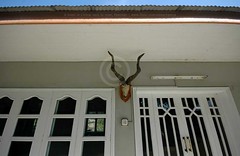
We walked around the massive walls of the fort only to be informed about the presence of Mir of Chitral's family staying within the premises. Despite the fact that this little kingdom was abolished by Government of Pakistan long time ago, this fort remains the personal property of the Mirs. People love them and they enjoy immense popularity in the city and beyond. I met so many Chitralis who told me that they would have been much happier had Mirs still be ruling Chitral district, as in previous times. But I and Adeel weren't at all happy because his presence meant we would not be able to go inside. Therefore, we turned sharply right and entered this beautiful guest house. And on its restaurant entrance there were these magnificent Markhor horns. I duly clicked and talked with its manager about tourists. He told me that the season was already closed and therefore, there weren't any tourists around here. We left without drinking our tea.
Sunday, November 13, 2011
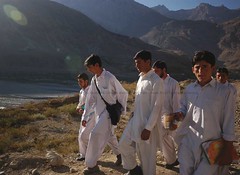
College students, Chitral district, Pakistan
Another photograph taken from a moving vehicle. So Zahid bhai advised me to increase shutter speed over 500/s and take a horizontal shot rather than an angled one. This helped as our Toyota was moving at over 80 KM / Hour speed.
Tuesday, November 8, 2011
Places in Pakistan: From Ghakuch to Gupis
Date: 20th Sep, 2011.
This is river shandur and we are travelling on our 16-seater, Pathan van. And we are racing towards Khalti lake. Earlier, after breakfast at Hafizullah's home we had got the van for Rs.7000 for the journey to Khalti lake and back to Gakhuch, the district capital of Ghizer dist. Our driver was funny but professional. And for us, the photographers, quite ready to stop his van wherever we wished it to be stopped. The sun was now shinning and we could see the glory of the mountains and the smashing noises the blue-green river made. Although it wasn't the best of time to visit the place due to early and long nights and cold weather we, nevertheless, found beautiful scenery all along the way to Khalti lake. The places are worth a day off. But due to shortage of time and funds we found it prudent to see them on passing.
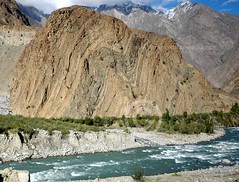
This is river shandur and we are travelling on our 16-seater, Pathan van. And we are racing towards Khalti lake. Earlier, after breakfast at Hafizullah's home we had got the van for Rs.7000 for the journey to Khalti lake and back to Gakhuch, the district capital of Ghizer dist. Our driver was funny but professional. And for us, the photographers, quite ready to stop his van wherever we wished it to be stopped. The sun was now shinning and we could see the glory of the mountains and the smashing noises the blue-green river made. Although it wasn't the best of time to visit the place due to early and long nights and cold weather we, nevertheless, found beautiful scenery all along the way to Khalti lake. The places are worth a day off. But due to shortage of time and funds we found it prudent to see them on passing.
Sunday, May 1, 2011
Fish for sale, Empress market
I uploaded this photograph to remind myself that I now urgently need fish. I need it to save my falling hair and to get a glow to my skin. And all that. I also need to remain young for a long time, or so my neighbour at boat basin informs me. Jailer sahib, as he himself likes to called for his father was in British police, told me that he has eaten fish for breakfast since he was my age. His age now is 75 and counting; mine is 29 and counting. And he has a load of hairs to prove it. And if those aren't enough, he has a booming voice which is usually reserved for Army wallahs. This jailer sahib is also lovingly called Munna Bhai, after the famous character of an Indian movie.
But he is right. Fish saves the day for men and women alike. And certain chemicals, which are not to be had in red meat, are readily found in fish meat. So I better go and just buy a handful now.
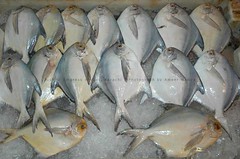
But he is right. Fish saves the day for men and women alike. And certain chemicals, which are not to be had in red meat, are readily found in fish meat. So I better go and just buy a handful now.
Friday, March 25, 2011
Frere Hall, Karachi
Frere Hall is one of the few well-preserved buildings from the days of the British Raj that still exists in Karachi, Sindh, Pakistan. Recently, it opened to public after Americans shifted their embassy to M.T Khan road. Therefore, security was relaxed, barriers removed and people of Karachi asked to throng the place. And they have already started that.
Frere Hall was built in honour of Sir Henry Bartle Edward Frere (1815–1884), who was known for promoting economic development in Karachi. Out of twelve designs submitted, the one by Lt. Col St. Clair Wilson was chosen and construction started in 1863.[1] It was opened by Samuel Mansfield, the Commissioner of Sind in 1865.[1]
The total cost of this hall was about Rs. 180,000 out of which the Government contributed Rs. 10,000 while the rest was paid for by the municipality.[1]
en.wikipedia.org/wiki/Frere_Hall
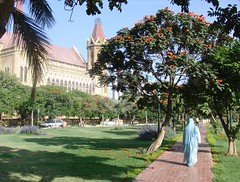
Frere Hall was built in honour of Sir Henry Bartle Edward Frere (1815–1884), who was known for promoting economic development in Karachi. Out of twelve designs submitted, the one by Lt. Col St. Clair Wilson was chosen and construction started in 1863.[1] It was opened by Samuel Mansfield, the Commissioner of Sind in 1865.[1]
The total cost of this hall was about Rs. 180,000 out of which the Government contributed Rs. 10,000 while the rest was paid for by the municipality.[1]
en.wikipedia.org/wiki/Frere_Hall
Wednesday, March 23, 2011
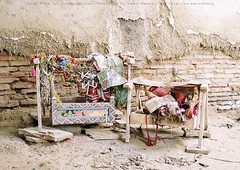
Minature Jholay, Tando Allah Yar
Women in Pakistan, most notably those of Sindh, Balochistan and Punjab regions, go to various Tombs of Muslim Holy men (also called Sufi or Aulia in Urdu and Persian) and ask for manat. They place these miniature jholas at their favourite tombs and request for the birth of a child from ALLAH via the Saint. When their wish is granted, they fulfil their promises to the Saint. That could be anything from giving charity to visiting the Tomb for consecutive months or even years. Some women even dedicate their child to the Tomb of the Saint as its keeper. Wahabis and Deobandis, both products of British rule in Saudi Arab and India respectively, reject this belief system and name it shirk (a concept within Islam which means that you place someone on the same pedestal as ALLAH or GOD).
Subscribe to:
Posts (Atom)


